Iceland has been hit hard by the financial crisis. Banks have defaulted, unemployment is rising and the currency has lost 80% of its value. Now Iceland is one of the first countries to go bankrupt.
Icelands bars are the countrys only success story of recent months. A lot of people come in now, says bartender Ludvig Ludvigsson, they drink because they feel that their lives are finished. Many of those coming in were previously wealthy bankers made unemployed by the crash. When the Landisank Bank went down it was particularly bad, recalls Ludvigsson. Senior policeman Geir Thorisson has also seen how fast things have changed since the banks defaulted in October. As money runs short theft is on the rise. But this is not the only problem the police face; protesters gather outside banks and government buildings and the mood often becomes violent. There are individuals who want go much further, to take down the entire administration, sack the parliament. In the docklands, construction sites for luxury flats lie abandoned next to the half-built National Opera House. Everyone is affected, says Rev Palmi Matthiasson. Kids listen to their parents whispering in the night time about losing their jobs, selling the house, how they will face the next day. And maybe we have not reached the bottom yet.
(Source: www.youtube.com)
What happen when a country go bankrupt? The following video on "Iceland Faces Financial Meltdown", dated Oct 2008, will tell you the answer.
The lesson from Iceland is, we need to closely monitor the representatives we have voted, the government formed, how they use the country's resources, and reserves. Any individual investor should not fall into the predator marketing of the bank or any financial institution, need to understand the investment, otherwise avoid investment in financial instrument you do not understand. Monitor the financial institution and your investment closely.
The last, not to be greedy, history always repeated.....
Watch the video, "The Sinking Island, Iceland(Nov 2008)" at the www.youtube.com; and open our eyes to all possibilities that may happen when country go bankrupt ; and remember, do not put all your investment in one basket, spread the risks........
We prayed for Iceland, that they will overcome......
Showing posts with label Place. Show all posts
Showing posts with label Place. Show all posts
Tuesday, August 4, 2009

Tuesday, May 12, 2009
After Sichuan Earthquake
A video taken from youtube.com. on Sichuan after the earthquake, may God blessed the survivors and for the years ahead. Their sorrow will be gone, and lead them to life with hopes and sweetness....and music of love forever..
Remember Mothers of 2008 Sichuan Earthquake
One year ago in 2008, 12th May; a deadly earthquake took place in Sichuan, China. The earthquake killed 69,227 people. It is called the 2008 Sichuan Earthquake, Great Sichuan Earthquake, Wenchuan Earthquake(汶川大地震). An earthquake measuring 7.8 to 8 m
Many mothers lost their life to protect their children..... Many mothers lost their children, and they are still having the scare of the sad memory...Remember these mothers on mother's day.
The kids have stand up and overcome.....Mothers of Sichuan, your kids are the brave children. We are proud of them....
Many mothers lost their life to protect their children..... Many mothers lost their children, and they are still having the scare of the sad memory...Remember these mothers on mother's day.
The kids have stand up and overcome.....Mothers of Sichuan, your kids are the brave children. We are proud of them....
Saturday, May 2, 2009
Lam Wah Ee Hospital(南華醫院)
Lam Wah Ee Hospital was located at 141, Jalan Tan Sri Teh Ewe Lim鄭耀林路(formerly Batu Lanchang Road峇都蘭樟路), 11600 Penang. The hospital is at the corner turning to Green Lane. It is a modern hospital with 422 beds. The Hospital is unique as it is having both western and traditional Chinese medicine department. But the main hospital is more focus on western medicine.
The idea of setting up a health care centre for Penang Chinese community was first mooted by leaders of Chinese community in 1876. A fund raising was started and a traditional style building was completed in 1883 on a plot of land about 10,600 sq ft at 36-38, Muntri Street (南华医院街), it was known as Lam Wah Ee Hospital(南華醫院). Lam Wah in Chinese Language or Mandarin means Chinese in the South. Ee is literally means medical treatment. First board of directors was appointed from 12 community leaders. The hospital provided free consultation and medication of traditional Chinese medicine to the public. The hospital become very popular not only to Chinese community , but also to other community.
The hospital opened 2 branches, the first branch was at 9, Beach Street (打铁街9号)and 2nd branch at 229, Jalan Magazine(头条路229号).
The hospital stopped its service during WW2 under Japanese occupation. The Lam Wah Ee hospital at Muntri Street was destroyed by Japanese bomb during WW2. It re-opened after the war in 1946 , and donation campaign was organized by the Chinese community to collect fund for the rebuilding of the hospital building. The double storey building was completed in 1955.

In 1959, the board of directors expanded to 24 members.
1960, a government clinic at sin-kei-tou closed down. The government required to use Lam Wah Ee to continue their service. This started the western medicine department of Lam Wah Ee Hospital.
The first branch was moved to Green Lane in 1961 to cater for the people in Jelutong and Green Lane area.The said land was reported by the hospital's own web site that the land was donated by British East India Company. But there was another source which said that it was coconut plantation owned by Mr Lim Siong Pan,on which was built Chee Seng Hospital to accommodate and recuperate the chiken pox patients. Which was the accurate source? But from my personal experience, during my school days when I took the yellow bus to grandma's house at Bukit Gelugor, the bus will passby the hospital; the said land was then a coconut plantation with some isolated buildings. East India Company (1600-1873)seems to be a long time from the moving of the branch in 1961 to donate land to the hospital; the Chee Seng Hospital is more conclusive.
The construction of new hospital building started in 1977, it took 5 years to complete the new hospital. The modern hospital was completed in 1983,with the generous donation from the Chinese community, especially Loh Boon Siew who donated the most .
Going back to Muntri Street, I searched for the old Lam Wah Ee hospital at 36-38, Lebuh Muntri(南华医院街 or Muntri Street); it is not easy to find the place. The building at 36, Lebuh Muntri; which is not only having Lam Wah Ee hospital Chinese Traditional medicine division; but also klinik Kesihatan Lebuh Muntri(Government clinic),and Heap Joo(Penang) Sdn Bhd in the same building. I need to ask the direction from a local to confirm the location. Now you believe the clinic is here.....

The sign outside 36, Lebuh Mentri clearly stated that it is a government clinic.Where is the old Lam Wah Ee hospital?

The building at 36, Muntri Street looked like a tyre shop. Look at the big bridgestone sign...
where is the old hospital?

The whole building seems to be occupied by Heap Joo(Penang) Limited Company. Is it hospital or commercial building? Look at the top of the building, it clearly stated the figure 1955, the year the building was completed, the year is the same as the completion date of Lam Wah Ee Hospital...
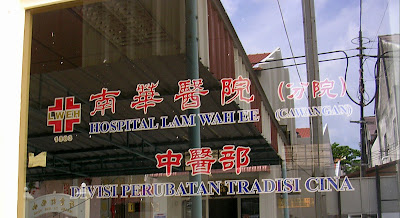
Going nearer, it finally revealed the name of Lam Wah Ee Hospital branch clinic of Chinese Traditional Medicine. It is the old Lam Wah Ee Hospital building....
The Lam Wah Ee hospital in Lebuh Muntri (南华医院街 or Muntri Street)is now only the branch clinic of Chinese Traditional Medicine division. It is no longer the main hospital. The main hospital is now at Batu Lanchang(now Jalan Tan Sri Teh Ewe Lim).


The 2nd branch is easily found, as I know the place since school days, it was located at 229, Jalan Magazine(头条路 or Magazine Road), a pre- war double storey shop next to a coffee shop. It is just opposite Komtar, the Trader Hotel. It was still operating after the war until 2004. The old notice at the wall revealed that the service had terminated on 31-3-2004. The notice issued by Lam Wah Ee Hospital was more than 5 years old and still stick on the wall. This place is going to be history....


This is the modern main hospital at 141, Jalan Teh Ewe Lim 鄭耀林路(formerly known as Batu Lanchang)for the western medicine.


The Chinese traditional medicine division now is at this building, just next to the main hospital building, but towards the Green Lane side.
The idea of setting up a health care centre for Penang Chinese community was first mooted by leaders of Chinese community in 1876. A fund raising was started and a traditional style building was completed in 1883 on a plot of land about 10,600 sq ft at 36-38, Muntri Street (南华医院街), it was known as Lam Wah Ee Hospital(南華醫院). Lam Wah in Chinese Language or Mandarin means Chinese in the South. Ee is literally means medical treatment. First board of directors was appointed from 12 community leaders. The hospital provided free consultation and medication of traditional Chinese medicine to the public. The hospital become very popular not only to Chinese community , but also to other community.
The hospital opened 2 branches, the first branch was at 9, Beach Street (打铁街9号)and 2nd branch at 229, Jalan Magazine(头条路229号).
The hospital stopped its service during WW2 under Japanese occupation. The Lam Wah Ee hospital at Muntri Street was destroyed by Japanese bomb during WW2. It re-opened after the war in 1946 , and donation campaign was organized by the Chinese community to collect fund for the rebuilding of the hospital building. The double storey building was completed in 1955.

In 1959, the board of directors expanded to 24 members.
1960, a government clinic at sin-kei-tou closed down. The government required to use Lam Wah Ee to continue their service. This started the western medicine department of Lam Wah Ee Hospital.
The first branch was moved to Green Lane in 1961 to cater for the people in Jelutong and Green Lane area.The said land was reported by the hospital's own web site that the land was donated by British East India Company. But there was another source which said that it was coconut plantation owned by Mr Lim Siong Pan,on which was built Chee Seng Hospital to accommodate and recuperate the chiken pox patients. Which was the accurate source? But from my personal experience, during my school days when I took the yellow bus to grandma's house at Bukit Gelugor, the bus will passby the hospital; the said land was then a coconut plantation with some isolated buildings. East India Company (1600-1873)seems to be a long time from the moving of the branch in 1961 to donate land to the hospital; the Chee Seng Hospital is more conclusive.
The construction of new hospital building started in 1977, it took 5 years to complete the new hospital. The modern hospital was completed in 1983,with the generous donation from the Chinese community, especially Loh Boon Siew who donated the most .
Going back to Muntri Street, I searched for the old Lam Wah Ee hospital at 36-38, Lebuh Muntri(南华医院街 or Muntri Street); it is not easy to find the place. The building at 36, Lebuh Muntri; which is not only having Lam Wah Ee hospital Chinese Traditional medicine division; but also klinik Kesihatan Lebuh Muntri(Government clinic),and Heap Joo(Penang) Sdn Bhd in the same building. I need to ask the direction from a local to confirm the location. Now you believe the clinic is here.....

The sign outside 36, Lebuh Mentri clearly stated that it is a government clinic.Where is the old Lam Wah Ee hospital?

The building at 36, Muntri Street looked like a tyre shop. Look at the big bridgestone sign...
where is the old hospital?

The whole building seems to be occupied by Heap Joo(Penang) Limited Company. Is it hospital or commercial building? Look at the top of the building, it clearly stated the figure 1955, the year the building was completed, the year is the same as the completion date of Lam Wah Ee Hospital...

Going nearer, it finally revealed the name of Lam Wah Ee Hospital branch clinic of Chinese Traditional Medicine. It is the old Lam Wah Ee Hospital building....
The Lam Wah Ee hospital in Lebuh Muntri (南华医院街 or Muntri Street)is now only the branch clinic of Chinese Traditional Medicine division. It is no longer the main hospital. The main hospital is now at Batu Lanchang(now Jalan Tan Sri Teh Ewe Lim).


The 2nd branch is easily found, as I know the place since school days, it was located at 229, Jalan Magazine(头条路 or Magazine Road), a pre- war double storey shop next to a coffee shop. It is just opposite Komtar, the Trader Hotel. It was still operating after the war until 2004. The old notice at the wall revealed that the service had terminated on 31-3-2004. The notice issued by Lam Wah Ee Hospital was more than 5 years old and still stick on the wall. This place is going to be history....


This is the modern main hospital at 141, Jalan Teh Ewe Lim 鄭耀林路(formerly known as Batu Lanchang)for the western medicine.


The Chinese traditional medicine division now is at this building, just next to the main hospital building, but towards the Green Lane side.
Thursday, April 23, 2009
History of Penang Adventist Hospital檳安醫院


Penang Adventist Hospital(PAH)檳安醫院, is a private medical institution which is part of global network of more than 500 hospitals and medical services. It is part of the chains of Seven Days Adventist Hospitals under Adventist Health System. PAH also operates Adventist College of Nursing. The hospital's mission is " To make a man whole", is to follow the ideals of God, the Master Physician, and to provide for your well being by ministering for your spiritual and emotional needs.
When you enter the main entrance of the hospital, the words " God Heals, We Help" greeted you. I liked the wording .....
The hospital is located at 465, Burma Road, 10350 Penang.
The history of Penang Adventist Hospital began on 12-12-1924, when Dr Earl Gardner opened the first seven day Adventist clinic in Malaysia at 108, Muntri Street,Penang. The clinic was called Seven-Day Adverntist Mission Clinic(耶稣复活团诊所). The large sign outside the clinic read " Seven- Days Adventist Clinic, Poor treated Free".

Seven-Day Adverntist Mission Clinic(耶稣复活团诊所)at 108, Muntri Street, Penang.

In 1929, the clinic begin to construct hospital at 465, Burma Road, Penang.
In 1931, Penang Sanitarium and Hospital was completed. In early 1932, it started to see its first patient.
The clinic of Muntri Street was closed and relocated to 511, Chulia Street,Penang, in 1932; while the hospital was still under construction. Another move in 1939, to 422, Chulia Street ,Penang.
1929年,是一个全新里程碑的开 始,槟安医院的建设工程正式动土. 1931年建竣;并于1932年初开始,正式大开门户为病人诊疗。

The Love Hospital, 1941
In 1941, Japanese army invaded Penang. Six months after Japanese occupation, they took over the hospital, and renamed it " The Love Hospital". Two years later, still under Japanese occupatio, the East wing was added,which was called " The Japanese Wing".

Penang Mission Hospital, the name changed after the WW2
After WW2,the Love Hospital was renamed Penang Mission Hospital. However the hospital eventually regained its old name, Penang Sanitarium and Hospital(or Rumah Sakit Peranginan dan Rumah Sakit Pulau Pinang in Malay language).

Right Wing ,1958
After the WW2, the demand for the medical care increased, and in 1958 the right wing was built.
It changed to its current name in the late 60"s, Penang Adventist Hospital(Rumah Sakit Advent), the name change was to be in line with the name change of other Adventist hospitals worldwide.
The new 5 storey building , which house 5 theatre operating suites, a ten bed intensive care units, deliver suites, a neo-natal intensive care unit, an imaging(X ray) department, laboratory, physiotherapy unit and three floors of patient wards. Today Penang Adventist Hospigal is having 212 beds.
Penang Adventist Hospital was the first private hospital in Penang, it was also the first to start the medical tourism in Malaysia. It started to provided service to international clients in early 1932, where it provided medical service to loyalty of Thailand. Today, it provided service to international customers, mainly Indonesian, and others included Japanese and European.
槟安医院是槟城首家私人医院,也是槟城保健旅游发展的始祖,早在1932年即接待泰国皇室成员,丹隆王子和他的两名女儿潘公主及比莱公主。经过80年的发展,槟安医院前后易名3次,不断兴建新病楼,同时引进最新的医疗设备及技术。
Note:
A private hospital is a hospital owned by profit company or non-profit organization, where the source of operating revenue is from the payment for medical services by patients,either from themselves(personal finance), insurance company , employer, or the embassy.
All private hospital in Malaysia, must be licensed under Private Hospital Act 1971.
Reference: www.pah.com.my
Old pictures of Penang General Hospital
The old pictures of the Penang General Hospital , some of the buildings should have been retained as heritage building, but it was not done. We have lost part of heritage. I hope the hospital authority when start any development on the hospital, to consult the heritage specialist, so that the necessary old building can be retained. The hospital is the oldest hospital in Malaysia, during the Strait Settlement day, this is also the site of administration on Singapore, Malacca and Penang. So, it is worthy to retain the old buildings if any 1882 building still around.

This is the maternity hospital , build in 1939 ,which is still use today. This is the hospital where my first child was born.

Block A, built in 1935

Nurse Hostel built in 1930, still use today

The native ward in 1882. The building has been demolished to build the administration block.

Part of 1882 hospital

1882 hospital, demolished and built nurse hostel

1854 hospital, is it at E&O Hotel site? or at the 1882 site
Note: The old pictures was credited to www.hpp.moh.gov.my

This is the maternity hospital , build in 1939 ,which is still use today. This is the hospital where my first child was born.

Block A, built in 1935

Nurse Hostel built in 1930, still use today

The native ward in 1882. The building has been demolished to build the administration block.

Part of 1882 hospital

1882 hospital, demolished and built nurse hostel

1854 hospital, is it at E&O Hotel site? or at the 1882 site
Note: The old pictures was credited to www.hpp.moh.gov.my
Wednesday, April 22, 2009
Penang General Hospital槟城中央醫院

 If you asked any Penang people who were born before seventy, where were they born, the majority will replied that they were born in Penang General Hospital. This is the place where most of us first see the world...but not me, I am born in the old city of Georgetown under home delivery, by my own grandmother.
Penang General Hospital or Hospital Pulau Pinang(or Hospital Besar Pulau Pinang (槟城中央醫院 ) is the state owned hospital under the federal Ministry of Health.
The hospital is located at Jalan Rensidensi(Residency Road),10990 Georgetown, Penang; with other various departments located opposite the road, along Jalan Sepoy Lines. It is actually a hospital complex. As public hospital it provided cheap health care and medical treatment to the people of the state. It has total area of 35 acres. It has 3 building blocks, block A,B and C, and other off site units, including Maternity Hospital and Psychatric Ward at Jalan Perak,Penang. It is the earliest hospital in the country.
The hospital has 1090 beds, First Class (75 beds), Second class (94 beds), Third Class(921 beds).
The earliest known hospital was reported to be set up in 1812 at the current site of Eastern and Oriental Hotel(E&O Hotel).
But Penang General Hospital has its history traced back to 1854,when a Chinese merchant with the name of Ah Po (some said Mun Ah Foo)established a Pauper Hospital (平民醫院)to provide for the needs of the poors and needy, and also rehabilitation for the opium addicts. He was the leader of Ghee Hin Society, a Chinese secret society.
Note: In the book "The Chinese in Malaya" 《馬來亞華僑史》, by Dr Victor Purcell(1896-1965) published in 1967, it was reported that in 1827, there was already a pauper hospital at the back of Penang prison, contributed 50% by the government, 50% by the private sector. Penang General Hospital may has its history traced back to 1827 or earlier, and may not be 1854 as reported.

Within the ground of the hospital, there was a monument commemorating the donors. It was a memorial tower with the various memorial stones placed in it.
The site of the original hospital was donated by Ghee Hin Society in 1886, as revealed by the memorial stone. Note: The original building has made way for a nursing hostel , which was constructed in 1930.
The surrounding wall and the ward was donated by Oh Yean Heng and Gan Kim Swee( 颜金水) in 1886. Gan Kim Swee was the owner of Aing Joo & Co and director of The Penang Khean Guan Insurance Company, Penang Opium Syndicate(1880-1888) under Chop Ban Bee. He was from one of the big 5 Hokkian family in Penang 1830-1890. Oh Yean Heng was also one of the party who was middle man between Ghee Hin and Toa Pek Kong Kongsi in 1867 Penang Riot, as a non- secret society Hockkian, together with other Hokkian community leaders requested them to guarantee no life and property lost.
There was a memorial stone dated 1879, with the following list:
1. The Toa Pek Kong Kongsi
2. The Ghee Hin Kongsi
3. Tan Beng Swee
4. Mess Noordin & Shaik Yousoof
5. Chulam Meydin Merican
6. Dalbadal & Yahaya Merican
7. Par Etam Kadir Hossain
8. Mahamad Joonoos & Mahamad Ariff
9. Meerah Pullay Kakah & Che Ismail
10. Shaik Ibram & Mohamad Fahar
11. Oauder Meydin & B Kadir Saw
12. Shaik Ismail & Mahamed Hassan
13.Abbosti Merican & Coopah Peechay
14. Shaik Emam
15. Chalonc Hajee Mahamed Noor
16.Abdul Cauder Merican
17.eliee & Mahamed Noordin Sultan Merican
18. Keechee Mahamed Shariff
19. Mahamed Chous Malim
20.Muna Mastan & Hajee Aboo Bakar


There was another memorial stone dated 1879, with the list of donors , the purpose of donation not stated in the memorial stone, believed to be the continued list of the earlier memorial stone, list is as follow:
Mahamed Amin & Mahamed Meydin
PeerMahamed & Sancardoss
Chandapa & Ong Hong Guan
Shaik Jan & Madar Saw
Pakir
The King of Siam also donated on 24-5-1890, industrial shelf.
Kindly take note that the Ghee Hin and Toa Pek Kong Kongsi are two Chinese secret societies in early Penang, they are rival gangs. Tan Beng Swee (1828-1884) was Kapitan China of Malacca and the president of Cheng Hoon Teng Temple from 1864-1884, was from prominant Tan family from Singapore. He donated to Tan Si Chong Su( 陈氏宗祠)in Singapore for Tan clan, which was built in 1876. A clock tower located in front of the Dutch square(Stadthuys), was named after him, donated by his son Tan JiakKim in 1886. (note: He is the son of Tan Kim Seng 陈金声(1805-1865), Kapitan China from 1847-1864, who donated the bridge nearby ,and the land for Chinese cemetery in Malacca,also set up Singapore's first fresh water supply line. Tan Kim Seng was born in Malacca, but made his fortune in Singapore as trader). The Merican family was also one of the main donors, they were Indian Muslim business family in early Penang. The donors are of mixed racial background,when at the time there were racial segregation, the non-European and European are having separate wards. (note it is not the culture of Asian to have separation of races, the wards for non-European were for all Asian races). The King of Siam was the ruler of Kedah at the time. I did not see any donation from the colonial master or any European firms......
The cost of construction was $90,997.
Note: This posting dedicated to my grandma who is still in the Penang General Hospital under critical condition)


The meaning of Pauper hospital
A Pauper in Latin is a person in receipt of relief, administered under the poor law. Under the poor laws, a person to be relieved must be a destitute person, and the moment he had been relieved he became a pauper, and incured certain civil disabilities. It also refer to those who are supported by charitable assistance, whether from public or private sources.
Under the poor laws, a person to be relieved must be a destitute person, and the moment he had been relieved he became a pauper, and as such incured certain civil disabilities.Pauper Hospital is the hospital cater for the poor, a pauper.

Subscribe to:
Posts (Atom)